
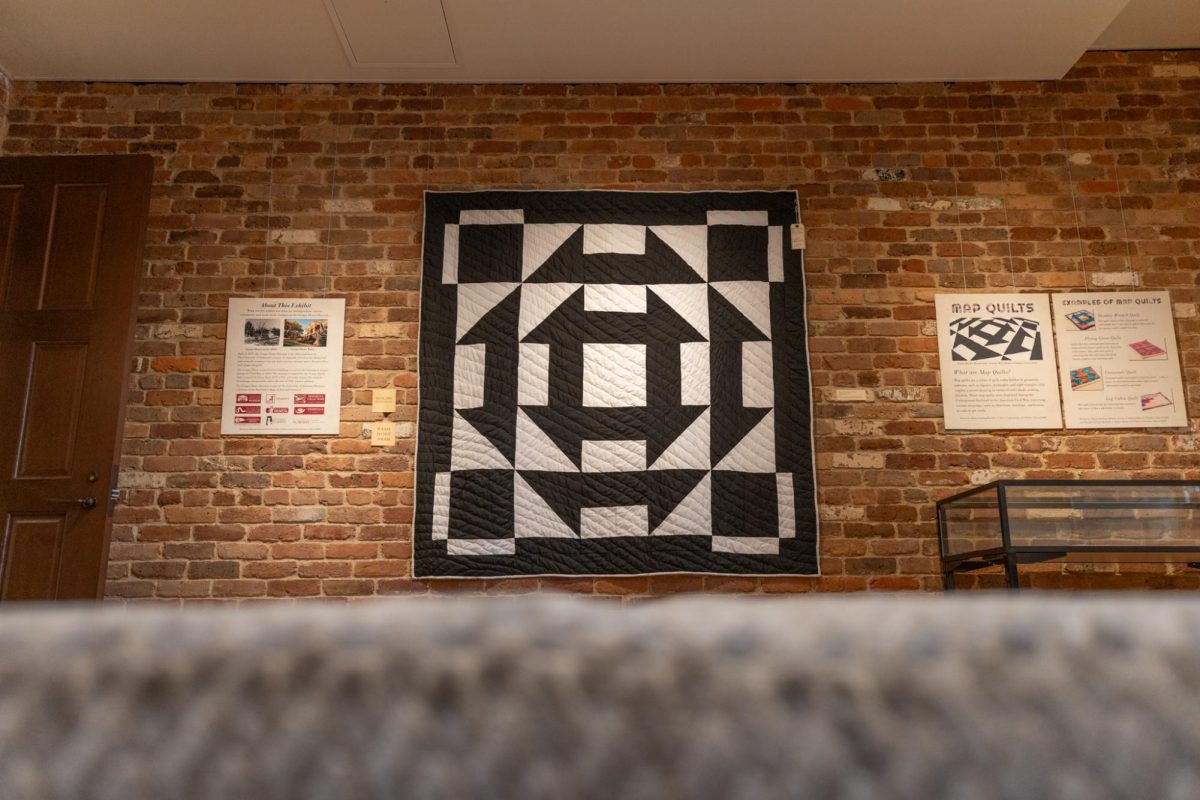
Stitched quilts were hung across the walls of the Moore-Wilson Gallery, including one hand stitched by University of Alabama students. These were displayed as part of the “Cotton, Cloth, and Community: Alabama Quilting Tradition” exhibit, which will run from March 2 until May 30.
The “Blue Jean and Corduroy” quilt by Gee’s Bend quilter Caster Pettway, on loan from the Freedom Quilting Bee Legacy, is made with patches of denim fabric and corduroy buttons on the left side to make an inverted T shape. Also on display was “8-Point Star” by Fannie Etheridge that was made in the early 20th century. It is an eight-patched quilt featuring a red and white star design with a blue background and red outline, separating the patches.
One of the participants in the event, Freedom Quilting Bee Legacy, is a new organization associated with Gee’s Bend, a community of Black women quilters from Wilcox County, Alabama, created to preserve the history of FQB and offer economic opportunities to artists.
According to Visit Gee’s Bend website, white officials in Camden discontinued the ferry service to Gee’s Bend, which isolated the community. The service did not start again until 2006.
Hannah Spencer, a senior majoring in political science and history and Gorgas House Fellow, was one of the writers of the posters for the FQB Alabama Quilting Tradition event. She took research involved with the historical upbringing of Gee’s Blend, how sharecroppers took over after the Civil War and Emancipation and how the community was affected with debt during the Great Depression to make a poster for the exhibit.
“The women from the Freedom Quilting Bee talked to us about how they liked their quilt to be displayed in a casual way,” she said. “You can’t be waving it around like a banner and being like this is the map, it would be displayed on a fence when it’s drying or just there to get the dust out.”
Spencer said there is a deep history in the construction of quilts, which served as communication tools for groups across the South.
“Map quilts are a series of quilt codes hidden in geometric patterns, such as squares, rectangles, and right triangles, that employ a secret meaning to enslaved individuals seeking freedom,” Spencer said. “These map quilts were displayed during the Underground Railroad in the American Civil War, conveying meanings, directions, warnings, safehouses or calls to get ready.”
The West Alabama Quilters Guild featured a quilt titled “Roll Tide Roll,” stitched by guild members. A heading at the top of the quilt says “Home of the Crimson Tide” with an image of the President’s Mansion and Denny Chimes. Throughout the quilt are squared patches with designs like houndstooth prints, Script As, elephants, quotes and outlines of Alabama.
The Tuscaloosa Bicentennial Quilt by Yvonne Wells, Becky Booker, Tonya Tidline, Amy Echols and Sharron Rudowski was presented on loan from The University of Alabama. It was created for Tuscaloosa’s 200th anniversary, featuring the Tuscaloosa Museum of Art, Capitol Park and Druid City Hospital on the obverse side and the Alabama state flag on the reverse side.
Allison Snelling, a senior majoring in anthropology and history wrote the “UA Students’ Quilt” was featured in the Gorgas House Museum’s 2025 exhibit “Stitching Together Our Legacy.” The quilt represented each UA student and what is important to them, including stitchings of a planet, a palm tree, Bible verses and a centered heart with the text “CA to AL.”
“This community quilt is woven together both by hand and machine,” she said “Seventeen patches can be seen on the quilt, each individually sewn by a student here at UA.”