

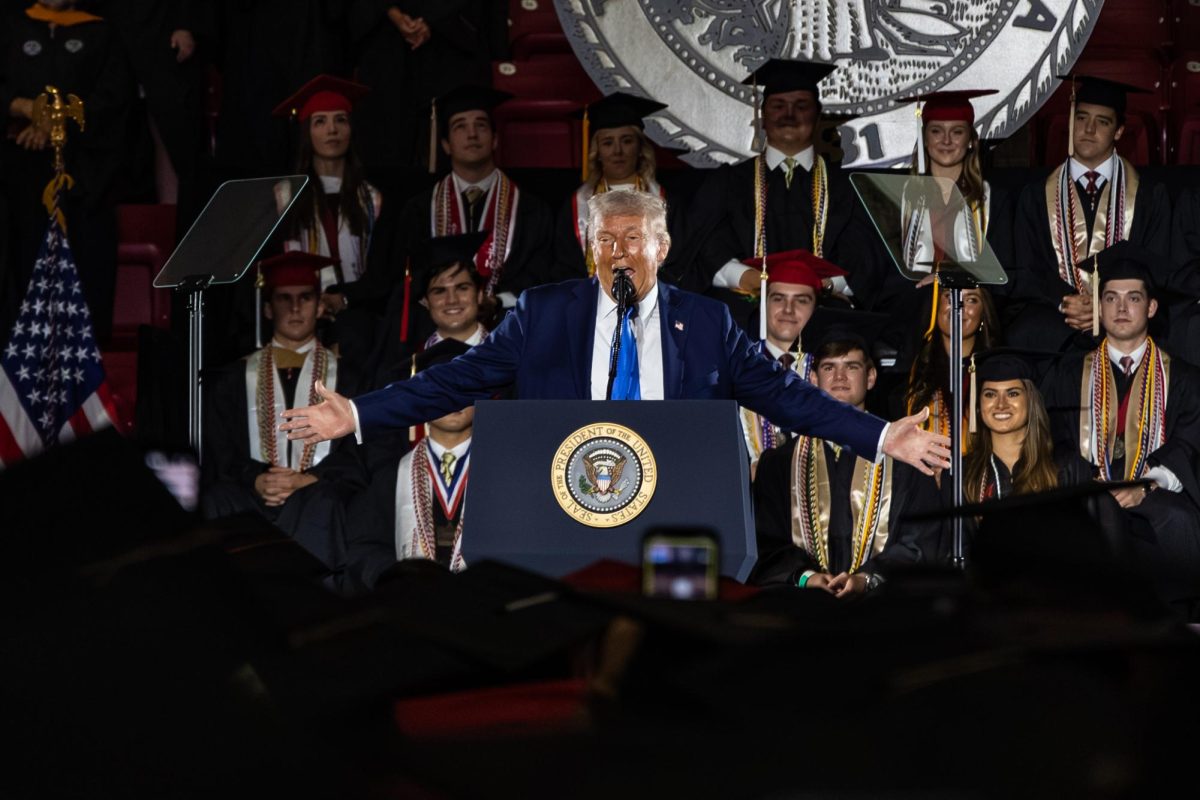
In the longest State of the Union address on record, marked by extreme optimism, President Donald Trump declared that, under his administration, the country has undergone a “turnaround for the ages.”
This optimism isn’t shared by the American people; according to a January Pew Research poll, only 37% of Americans approve of the way Trump is handling his job as president. Only 30% of Americans aged 18-29 approve. If the sentiment of the American people does not reflect that expressed by the president, then why can Trump not level with the majority like President Gerald Ford did in his 1975 address, in which he stated that “the state of the union is not good”?
The reason is clear: Trump’s State of the Union address reflects the broader fruitlessness of the administration.
The current 119th Congress has had a record low number of bills signed into law for a modern Congress, somewhat understandable given Republicans’ gauntly thin margins in the House and the difficulty of passing anything through the Senate. By contrast, Trump signed more executive orders less than a year into his second term than he signed in all of his first. Despite all the chaos surrounding this administration’s actions around deportations, the rate at which it is deporting people is lower than the peak during the Obama administration. Additionally, much of Trump’s tariff policy was recently struck down by the Supreme Court.
Even when the President tries to use his speech to spur the passage of some much-needed legislation, his attempts do not succeed. Trump asked Congress during his SOTU address Tuesday to pass the SAVE America Act. Thursday, Senate Majority Leader John Thune said there were not enough votes to amend the filibuster to pass it. This is a similar story to what played out when a Democrat-supported voting rights bill failed to pass the Senate in 2022. Any impact this administration has on voter rights will probably not come through legislation.
All of this is to say that the current administration is accomplishing only a fraction of its goals. It has not reached the level of deportations it aimed for. It has not brought down prices — at least not nominal prices. Its tariff policy was recently struck down. Immigration and high prices were two of the biggest issues that helped the President win election in 2024, and he has failed to address these issues sufficiently. For this failure and other abuses, voters are starting massively to disapprove of his job as president.
Unable to pass much legislation, it has instead relied on executive orders, which can be easily undone by the next president. The administration may be able to cause temporary harm now, but its long term domestic policy impact is limited.
What do we get instead of productive legislation? We get moments like Trump saying during his address to stand up if you believe that “the first duty of the American government is to protect American citizens, not illegal aliens” and then condemning Democratic Members of Congress for not standing. We get the Department of Homeland Security posting Little Dark Age edits on Instagram trying to recruit for ICE, though the audio has since been removed. We get DHS posting edits on X celebrating mass deportations.
The government cannot deliver much in the way of concrete policy outcomes, so it instead focuses much of its efforts on signaling to its supporters that their cultural group, particularly the online-right, is in power.
The current administration is not alone in this failing. The Biden administration and campaign also grasped for relevancy by referencing “Dark Brandon.” The problem of the American government failing to deliver material policy changes is likely deeper than a single person, party or administration. This SOTU showcases the general paralysis of the American government. The administration cannot sufficiently address issues voters care about, and as a result, the President and his administration must try to assuage them through empty words.