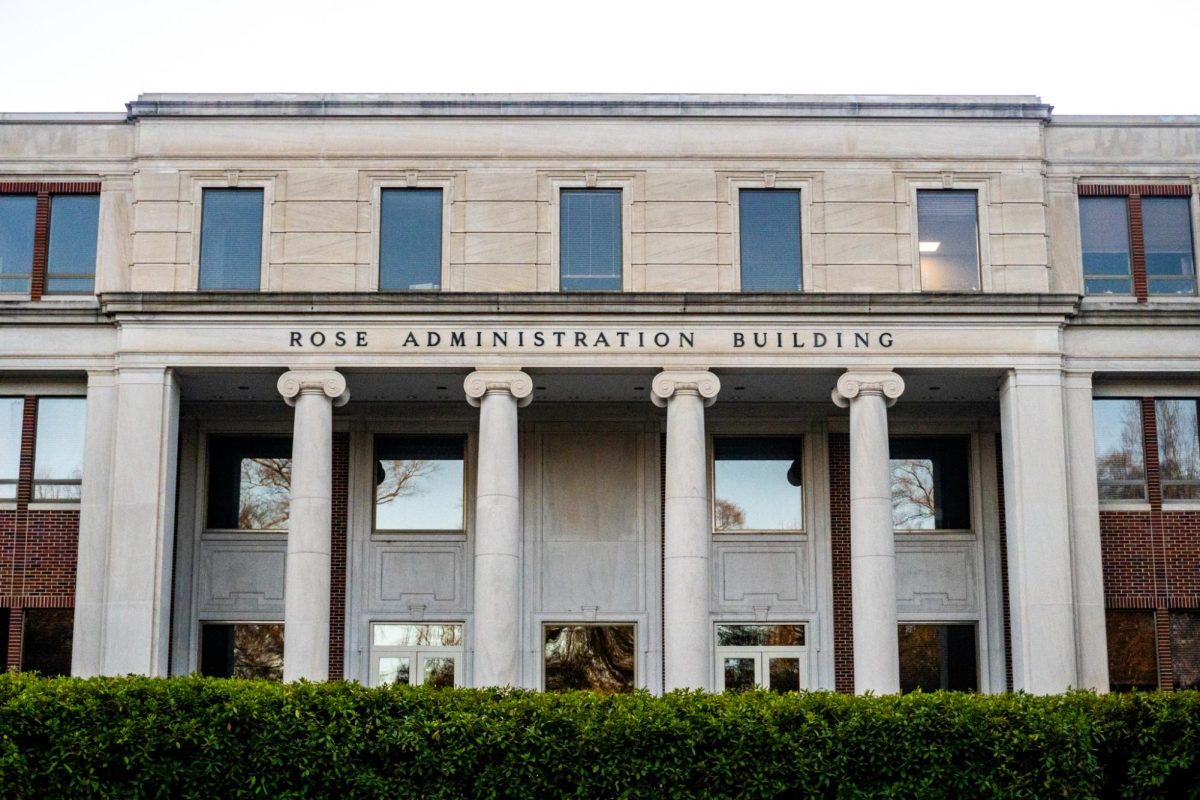

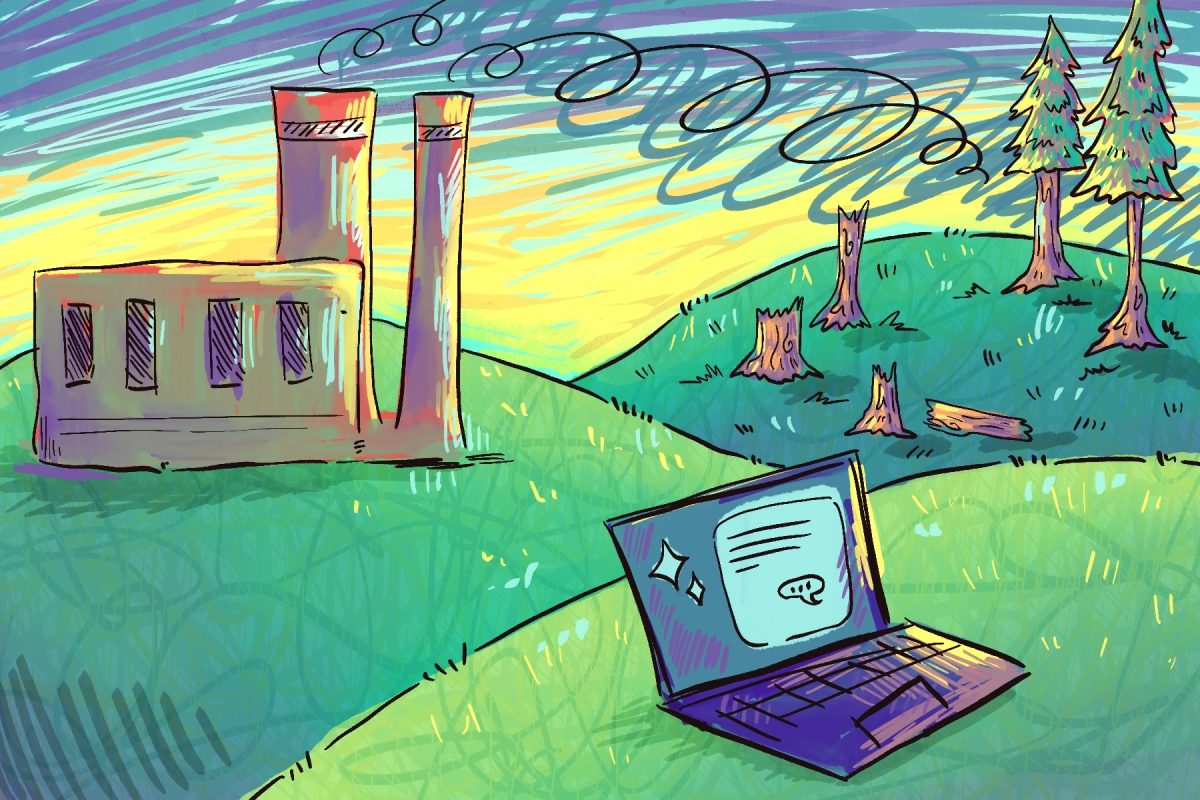
The University of Alabama has worked to implement artificial intelligence models at various levels, planning to create programs that can aid in tutoring, advising and even groundbreaking research on topics like particle physics and quantum mechanics. However, AI comes at an environmental cost, causing experts and UA students to call for changes to the way both corporations and academics use machine learning technology.
Data centers are among the top consumers of utilities, including energy and water, in the country, and they are growing rapidly. The University is in the process of building its own on-campus 14.6MW data center, equivalent to the power consumption of almost 12,000 households, with planned scalability beyond 16MW. The 2024 Census found Tuscaloosa contains over 40,000 households.
The power draw of the High Performance Computing and Data Center is enough to require a dedicated electrical substation and chiller plant, a facility that creates cold water for cooling. In a statement to The Crimson White, the Tuscaloosa office of Alabama Power said they were “committed to supporting the University of Alabama’s growth,” as well as the HPCDC.
“We meet regularly with the university to discuss and strategize around current and future energy load requirements, ensuring we are prepared to meet increasing demands reliably and safely,” the statement said. “Our focus remains on fostering a strong partnership with the university and supporting the local economy through robust energy infrastructure planning for years ahead.”
Matthew Hudnall, a UA associate professor of management and information systems and member of Gov. Kay Ivey’s Generative AI task force, said that the power draw of the new data center was equivalent to a “small city,” but that Alabama Power already has the transmission lines to support that consumption level in the area.
The High Performance Computing and Data Center did not respond to a request for comment sent via email.
While scientists across the world are trying to gauge the potential impact of the technology and its power consumption needs, their work is being outpaced by the rate of investment. The United States Department of Energy estimated that by 2028, data centers will double in power demands from 2023, consuming roughly up to 12% of all electricity in the United States. As AI firms become increasingly competitive, that power demand could scale even further.
“Everyone wants to train the next generation LLM or AI model very quickly, but if we just slowed things down, there would be efficiency benefits,” said Noman Bashir, a researcher at MIT’s Computer Science & Artificial Intelligence Laboratory and the computing and impact fellow with the MIT Climate and Sustainability Consortium, in an interview.
Bashir said that for-profit companies are at the center of AI investment and research where, in the past, academia was the biggest driver of AI progress. Now, academia is largely being priced out of cutting-edge AI training due to the extreme cost of graphics processing units, the computer chips that power AI technology. The University was only able to start its data center project with the assistance of a $44.6 million federal grant.
“For-profit companies are controlling all the innovations and developing the narrative around AI,” Bashir said. “There may not be an unbiased opinion to counter that, since they control everything.”
The University’s upcoming center, spanning 40,000 gross square feet, is only a fraction of the size of the for-profit data centers in the Atlanta suburbs, which can range upwards of a million square feet. Bashir said that the relatively small size of academic data centers might be a good thing because they use up so much power and water that they impact the utilities of local residents. The rates and electrical grid improvements for data centers are also subsidized by resident bills, increasing the price of water and energy for regular people.
In Newton County, one of the areas in Atlanta where Meta is building servers, residents’ water faucets have reduced to a trickle. Bashir said that data center power usage can also cause appliances like microwaves and refrigerators to run hotter, causing damage over time.
“In general, there are also health impacts for the people surrounding data centers or power plants that are part of new data centers,” he said, referring to pollution and environmental contamination.
Bashir said that the increase of AI in consumer products has also led to the tool being used in situations where it isn’t necessary or, sometimes, even asked for. For-profit AI companies also hide their costs by making services free, even if it has to be funded by taxpayers and investors. This artificial increase in demand leads to more strain on data centers and, consequently, more pollution.
The debate on AI’s overall impact is rather nuanced. Environmental groups and businesses are also leveraging AI to benefit their work.
Bashir said that academic research on AI has real potential to leverage the technology for more efficiency and innovation, provided researchers reassess their priorities.
University students also say they are hoping to use the technology for research and see the potential of its raw computing power.
“There are a lot of applications in ocean conservation and remote sensing,” said Fynn Remhof, a freshman majoring in environmental science.
Remhof mentioned one company, SeaView, that manufactures submersibles called reef sweepers that can be piloted remotely by a human, like a drone. These machines use AI-powered targeting systems to spear lionfish, an invasive species that has devastated marine habitats in the Gulf of Mexico.
“It can kill hundreds a day,” Remhof said. “They’re pretty cheap. $600,000 for a big machine that can have a lot of economic impact.”
She said that AI can also be helpful for surveyors using Geographic Information System mapping software because they can deploy drones to do some surveying without human interference. Using computers to accomplish these tasks can free up humans to do more work that benefits environmental research. Still, Remhof said that she was worried about for-profit exploitation of consumer AI.
“This is just a ton of energy,” Remhof said. “It’s not sustainable. We cannot keep doing it. And obviously, if it keeps ramping up, it’s only gonna get worse and worse.”