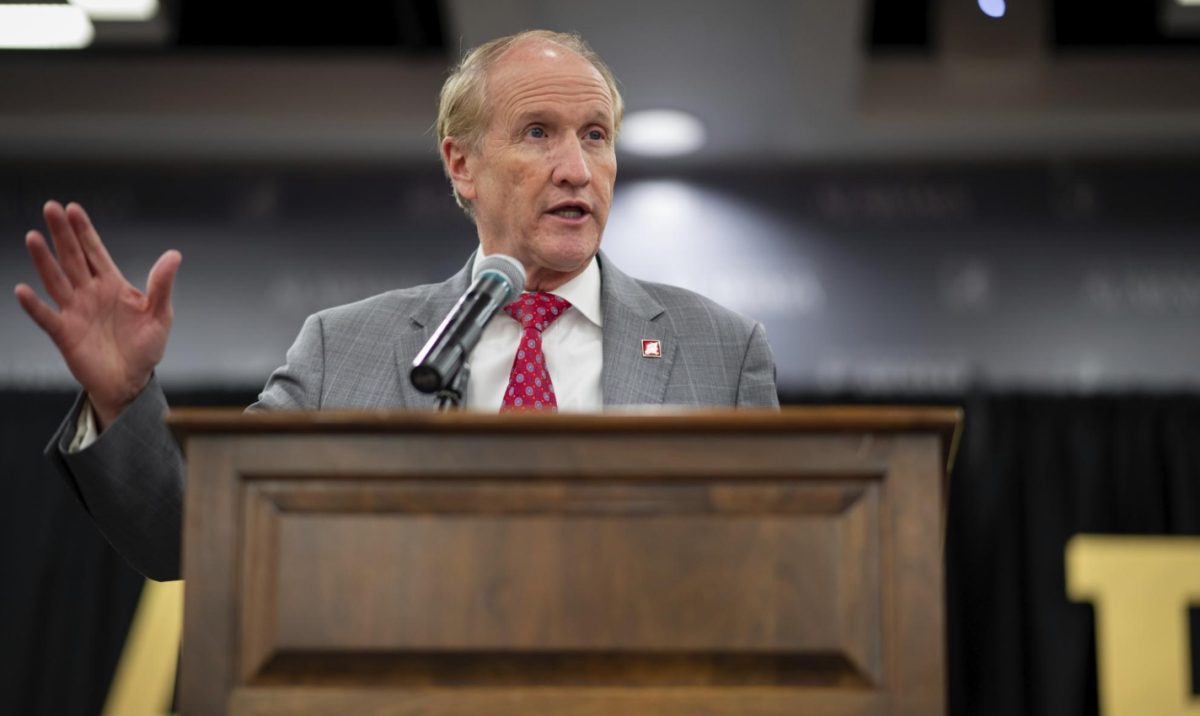


Harlie Hicks is a sophomore majoring in sport management. She is running for vice president of academic affairs in the 2026 SGA election.
Q: Why is it that you’re running for vice president of academic affairs?
A: I’m running for basically all those people who aren’t involved in anything else on campus. I’m a first-generation college student, so I’ve never had any background knowledge of what to do. And when I came here, I knew that there was resources, but had no idea how to get to them. So that’s my main thing that I want to focus on is getting those resources to people like myself who might not know where anything is. Like, I just told him I didn’t know this was here. So I definitely just want to bring a lot more awareness to scholarships and stuff like that. Because I think a lot of students on campus do not realize how much is going on, even on game days. I’m like, “Oh, I didn’t even know there was a game tonight.” So I just want to bring a lot more awareness to not only academics, but also students in general, for registration and adding and dropping classes and all those little things that you don’t even think about. I do want to start a program with majors or something where you can talk to an upperclassman who might be in the same major as you. So that way you kind of have an idea of what you’re actually going to be learning before you do it. Because a lot of people change their majors two years in. So I think we just need a lot more stuff at the beginning of your first two years here. So that’s one of the things that I want to implement.
Q: Why do you think you’re the best candidate for the position?
A: I think I’m the best candidate for the position because I have been in leadership positions, and I’ve always made some type of change. I never just sit there and kind of just do what is normal. I think a lot of people, when they’re in leadership positions, they kind of just be in charge. Do whatever you got to do, but that is the only thing I would say I miss part of high school, because when I was in high school, I was part of a bunch of organizations, and when I got here, getting into organizations here it’s 10 times harder. So that’s where I’m like, I want to have more accessible resources, organizations to everyone, because I think a lot of students here don’t actually get involved, because their first year here, they’re just like, “Oh, I didn’t get into something, so I’m not going to try again.” So for me, I think that I’m the best candidate because I’ve experienced those things. I have background experience. I am a first-generation student. I’m a out of state student. I have all these different experiences, and I’m always willing to listen. I definitely want to have monthly zoom meetings or whatever, or even office hours where people can message me or zoom with me or whatever and talk about things that I might even not know that’s an issue. So I just want to have someone in our SGA that’s like, actually going to do stuff and actually listen to people and, like, advocate for them. So I’m definitely big on let me be that person, because I want to do it.
Q: What are your campaign’s key platforms?
A: My key platforms are mental health awareness. I would love for our entire campus, like faculty and stuff, to go through more workshops before classes start, because I think a lot of students here go through a lot of mental health issues from going through their first years of college. Like, it’s a very big life change, regardless if you’re out of state or whatever. So for me, I would like to implement a lot more mental health awareness just in the student setting. Of like classes, put that in the syllabus. Of like, if a student has this, they’re allowed a certain amount of days or so, so kind of just putting that into syllabi, so that way it is a standardized thing. Because I think a lot of professors are very one way or the other about that. So if there’s just a certain thing, that would be great.
My other one is academic transparency. I’m very big on I wish that everyone here could see all the different options that they have before they actually have to go through stuff, because, like I said, a lot of my friends have changed majors and all these things, and they’re in their sophomore year, but I could not imagine being a junior and having to do that. So for me, I want to bring a lot of transparency, where we have something where students can look up. Okay, I did this class, but I like this certain aspect of it. So what other classes are like that? So that way they can see like oh but I want to change my major or have a minor in something like that. Because I think a lot of people don’t realize. Like, I’m sport management-is more business than, like, actually sports. So like a lot of people think when I say that, that I want to be, I guess, more like kinesiology, like an athletic trainer. So to me, I think that needs to be a very big thing, like having distinct parts of classes that actually regulate to what majors are, so that way people can actually know what classes they need to take.
I also want some type of transparency with advisors, because from my experience and my friends and the Honors College, I think it’s a little insulting whenever you’re going through advising. And a lot of people want the easiest options, but not everybody. So that’s where I’m very big on. Every person that got here went through their one process. But not everybody has the same goals. Not everybody has the same thing. So even though we all worked our butts off to get here, we all have different plans. We all have different things that we want to do. So for me, not saying it’s anyone’s fault, it’s just we need to bring more programs, more workshops. So that way, there is awareness for mental health, there is awareness for people who don’t have any support from people who might have gone here. I think there is a lot of people who are here. They’re like, Oh, I’m from Alabama, and I know this school. And there’s a lot of people who don’t. Like we have a lot of international students too. So, for me, I just want to make life easier for everyone. I know what it’s like to get overwhelmed with classes and registration, and because I have a disability, I am one of the first people to get priority registration, but everyone else doesn’t get that. So that’s where I’m like, even if you don’t have a disability, you might still have some type of mental health issues. So that’s why we wanted that to be a big aspect of my policy as well.
Q: What two specific initiatives do you want to accomplish, and what time frames do you hope to accomplish them?
A: Okay, my first one is going to definitely be in the first month of being in office that I would really like to implement more basically, the what I was talking about, like the meetings. I think right now, spring semester, in my opinion, is 10 times harder than fall, because it’s very compact. So I think my first month of being in this position, I would like to create some type of anonymous form or anything that if you have any questions of anything, you can go fill out a Google form or something and someone will reply to that. Or we can find an upperclassman who’s willing to talk about those different topics, or even a professor, because I had a first-gen mentor, but since I’m in my second year now, I don’t have that. So that’s where I’m like, I understand your first year might be the hardest, but I still think we need those little mentorships throughout college, because you might change your major along the way, and stuff. So for me, the first thing I would implement are those little advising, like hours, like workshops and stuff, because I want to hear everyone’s opinions, and part of my campaign team is literally making polls and questions to see, like, even before we get the position. What do people want? So that way, we can have a kind of a game plan before we even get started, because I have ideas, but I would love to hear from other people, because I know I’m not the only person on this campus.
Q: And, do you have a second initiative?
A: Yes, but I think that one’s going to take kind of longer, so I’d probably say more towards graduation time. This semester, I would like to implement the initiative for next semester of having faculty actually do those workshops and the mental health and stuff. And also, I think some students should get some type of academic survival guide type thing. I want to build something like that. And I think in the next, if I put the time into I could definitely have that in the next month. So that’s why I’m, like, if I’m given the opportunity, I could have these things out really quick, because I have ideas.
Q: How do you plan to adapt if your initial plan for achieving those goals doesn’t go how you help?
A: Well, that’s always a possibility. So that’s why I’m open to all the different options. I’m open to all the different things. So my opinion, everything’s always on a spectrum. If you can’t get everything 100%, I think you should try and take anything with a grain of salt. Because it’s like, okay, I definitely know that a lot of people on this campus get stressed out about the 10-minute increments in between classes. So to me, yes, that might be something really small, but just adding like an extra five minutes would really help people. And it’s like, yes, you can pitch for 20, but even if you just get 15, that’s still something. So to me, I think just those little marks along the way is like going to be kind of my way to if I don’t get the big one figured out. Okay, let’s- what little, small steps can we do to try and get there at a different point in time if they’re not willing to do it right now?
Q: What experiences have you had on campus that you believe will help you in the role if elected on campus?
A: I have been a part of the Honors College since I have enrolled here, and my first year I was in the living learning community, so I was around all honors students, and I absolutely was terrified, because, you know, like you’re set at a higher standard, and it’s a very different environment from my high school, where I was like, top of the top, and then you’re putting an environment with a bunch of people who are the same as you. So that experience in itself,when I realized that this isn’t in high school those leadership positions, I kind of questioned if I was given them because no one else wanted to do it, or if I was actually that type of person, but when I got here, and there was people to do those positions, and I was still fell in those leadership, like spots, even though I was a freshman. Like in our Living Learning class, we have groups that we did, and I always ended up being the group leader, instead of just because of my personality, and I was willing to take action and initiative. And I think just being a very open and optimistic person kind of keeps pushing me into those positions, because I have joined organizations on campus, but I’ve never gotten into those officer positions. I don’t know why. But I want to find a way to be involved in some type of organization in that type of way, because I know in the academic setting I have done that, it’s just not the actual social settings.
Q: How do you plan to make sure students are aware of internal and external academic opportunities?
A: So for me, I think scholarships are one of the biggest things that need to be very widely like, told to people on campus, like, it definitely needs to be more awareness to that. So for me, I think basically kind of going back to that Google form of, like, anonymous questions and stuff, I definitely think there needs to be some type of help with students, because, like I said, certain students need certain things. And yes, there is different colleges, but also certain colleges have a lot bigger standings and our senators and stuff. My college has only four people, and that’s different from the business college. So to me, I think making those little like, I guess realizations that not every school is the same, or not everything is the same, as like, taking that extra time to take the initiative to actually. Okay, this might be an internal issue for the business college, but CHES doesn’t need to worry about that right now. So it’s kind of just, I guess, being a big scheduler and figuring out what’s the best game plan for everyone else.
Q: How do you plan to improve the academic experience at the University?
A: I’ve always been big on academics, and I’ve always found learning to be really fun. So to me, I want to kind of bring that to everyone else on campus. It sounds silly, because I know a lot of people don’t like learning sometimes because it’s kind of boring. But in the few classes that I’ve had, I’ve realized, like, sometimes the only way you can make it more fun is just by being optimistic, by telling someone like, Oh, hey, do you want to study after your class? So to me, I’m like, I think you can make academics a lot more fun and interactive by just being, I guess more involved with your academics. I think if you’re part of the SGA or anything like that, like, you shouldn’t be afraid to be one of those people in your class that’s like, Oh, hey, you don’t want to do a group session or anything, or like, host those types of sessions. Like, I know you have tutoring on campus, but it’s very like, if you want to be a tutor, you have to have certain qualifications for certain classes. So to me, I think that there needs to be some type of information of for this specific class- who would have any help with that? And I know we have we have a new like thing going on. I think it’s the circle hub or whatever that’s like for
specific classes. I would like to really use that in classes, and really make professors kind of like, okay, if you have a group project, do it on here, so that way you’re not worried about, oh, someone lost it on their phone, or anything like that. All of it’s like on Blackboard, but a completely different website. So I guess making sure that technology is a lot more consistent, I guess, because I think a lot of people on this campus are like, oh, I don’t know what Ultra is, and all those different things. So just having, I guess, more standardized stuff, so that way everyone’s on the same page, would be really nice to have.
Q: What’s one last thing you want voters to know about you?
A: Well, for me, personally, I would love for voters to know that I am not the average person on this campus. I have gone through a bunch of different things, and even though I know the picture I put on there, you know, I look kind of basic. I guess that’s what I’m trying to say. But in my head, I definitely think that I want my voters to know that if you need anyone, I will always be that person that’s willing to be open and talk to anyone, because I do have the extra time, I am willing to do those things, and I’ve already proven that, not only in my high school experiences, but in those classes, like I go to extra office hours, I go to extra things to help my friends in my classes, because I want to do those things, I’m a very open and helpful person. I’ve always liked being someone that people can rely upon. So, for me, I want everyone who’s voting to know that if you want someone that you feel you can rely on to help you with your academics, I think you should vote for me.