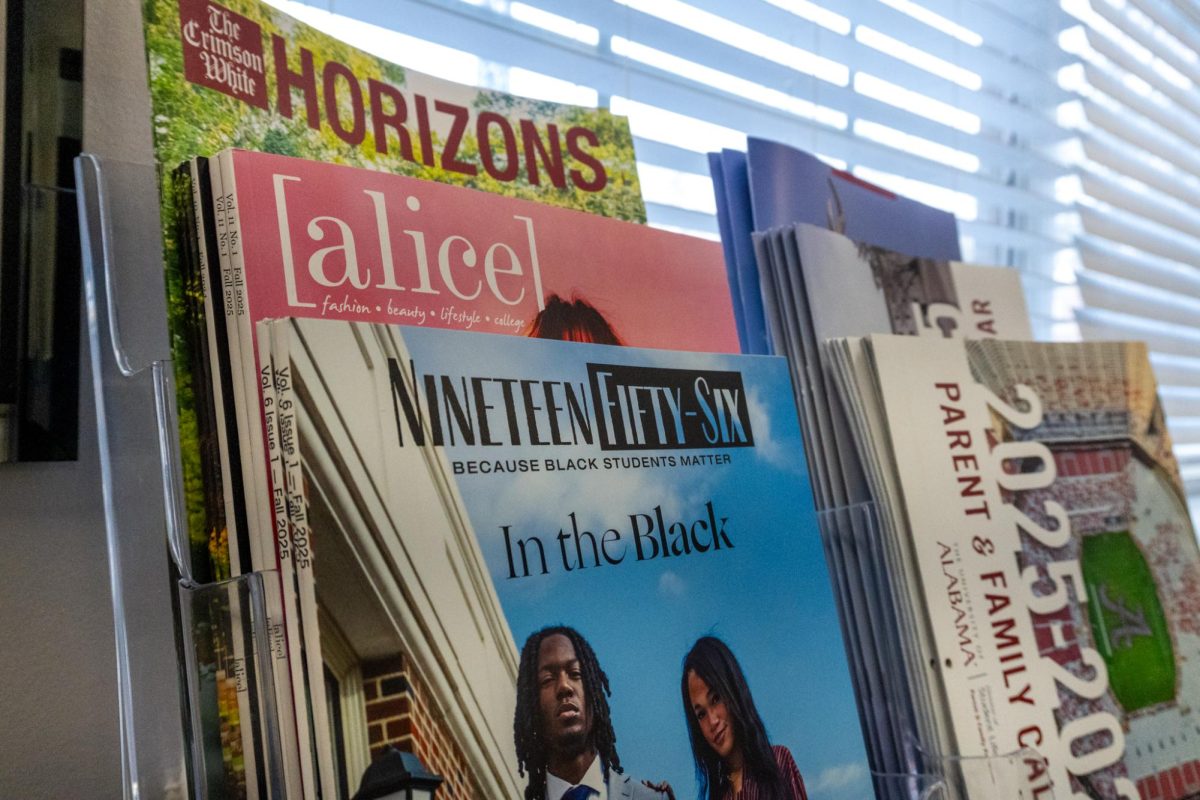


The fight for student journalism and free speech is ablaze at The University of Alabama after the University shut down two of our student magazines, Alice Magazine and Nineteen Fifty-Six last month.
On Dec. 1, a memo from the Attorney General published in July was used by university staff to justify the magazine’s suspension.
In the memo, it says nothing about content and free speech that highlights student experiences and perspectives, rather it says that “the federal government will not stand by while recipients of federal funds engage in discrimination.”
Presumptively, “discrimination” refers to groups that gather based upon like identities, and while Alice Magazine and Nineteen Fifty-Six tailor their content to specific demographics, they do not discriminate against other identities.
It is imperative that we set an example for pushback against discriminatory violations of First Amendment rights — because while this is our first fight for freedom of the press, the greater collegiate journalism community has been and will continue to face restriction and censorship in an increasingly hostile press environment.
The Foundation for Individual Rights and Expression’s report notes that 68% of college editors experienced censorship, including both overt and implicit, in the last year. The majority of these editors describe experiences with administrative requests or demands to avoid reporting certain content, including topics like campus crimes, Title IX issues and anti-DEI policies.
More extreme examples include overt threats to funding, staff, and distribution. During homecoming week, administrators at Indiana University told the student newspaper, the Indiana Daily Student, to only report on events related to homecoming. After the incident, the Director of Student Media at Indiana University, Jim Rodenbush, was fired for refusing to censor the newspaper’s publications.
“Within the same week DEI was dropped at Purdue, they ended our distribution,” said Olivia Maples, Editor-in-Chief for the former Purdue Exponent. “They didn’t give us any notice, citing a contract we haven’t signed since 2014, which is technically true, but we’ve been acting as if we had signed it for years. The main thing was that they didn’t really give us any notice.”
It is attacks like these that depict an unhealthy democratic process since a free press that provides news to the people is necessary to combat discriminatory and corrupt practices that otherwise influence political spaces.
It is not simply major news networks that bear the burden of informing the public. College newspapers are integral parts of their local communities, often reporting on local issues, new businesses, and the local impacts of policies that may not be covered by larger news networks.
Take the Crimson White. In the fall of 2025 alone, we reported local events such as the Dickens Downtown Christmas event, City Council demolitions, local Megachurch corruption and the opening of Zoë’s Kitchen.
“Student news is very important for local articles,” Maples said. “I think when people think of news, they think of the big developments and not so much city council or a random bakery that just opened, and with less student news, they would just miss that integral part of the community. And that’s one of the best parts of having a local paper.”
However, even without explicit censorship, the unique relationship between a university funded paper and its freedom to print inherently complicates the ability to expose unattractive truths. Student journalists feel pressures to cover topics like DEI with caution, knowing that their voices may make conservative administrations uncomfortable.
“Student newspapers are complicated, since you’re studying at the university that you’re exposing through your writing,” said Jason Willis, the Editor in Chief of The Reveille, the student newspaper at Louisiana State University. “Because we’re funded by the administration, they don’t want us to damage their reputation. But at the same time, we need to simulate the real journalism world and exercise real behaviors of transparency.”
Because censorship at both the college and professional levels threatens the freedom of our expression, increased volatility from administrations and polarized audiences can make it difficult for journalists to feel comfortable expressing opinions against this suppression.
“I do think we’re seeing censorship around different college campuses right now in a way that I haven’t seen before. And it is very alarming to me,” said Caden Layne Dyer, editor-in-chief of The Daily Beacon, the student newspaper at the University of Tennessee. “So all the stuff that happened with IDS [Indiana Daily Student,] what’s happening with y’alls’ magazines that are being censored and cut right now — I think it’s very telling that it’s happening at a time when nationally, there are also attacks on the press.”
Colleges aren’t the only targets of free press attacks. In October 2025, Defense Secretary Pete Hegseth required journalists of the Pentagon Press Corps to sign reporting guidelines that required all pieces to be approved by White House staff to ensure no unapproved information be published, leading to nearly all journalists with Pentagon pressroom desks to vacate Capital Hill.
Similarly, The Associate Press lost access to White House events following Karoline Leavitt’s demands that they default to the use of the ‘Gulf of America’ rather than continue to protest its adoption through the use of the ‘Gulf of Mexico.’
While SEC schools fight on the football field all fall, their journalists are united in the beliefs that freedom of the press and free speech are necessary to preserve the future of our democracy. Insofar as we are the next generation of journalists, the truth is in the hands of practices currently being unfairly targeted.
“In order for journalism to thrive, it must be left alone to its own devices,” Willis said. “A healthy relationship is hands off. There should be no interaction through the editorial process. Otherwise, we lose the opportunity to simulate our future career and do real journalistic work.”
The only way to protect the freedom of the press is to continue publishing works that expose the discriminatory actions of administrations throughout the SEC and professional journalism spaces. Already, students and UA Alumni have pushed back against the suspension of Alice Magazine and Nineteen Fifty-Six, but this pushback must continue in order to prevent further suppression of free press spaces.
Editor’s note: This story was updated Jan. 9 to correctly state the university of the Indiana Daily Student newspaper. The IDS is Indiana University’s student newspaper, not Indiana State University’s.