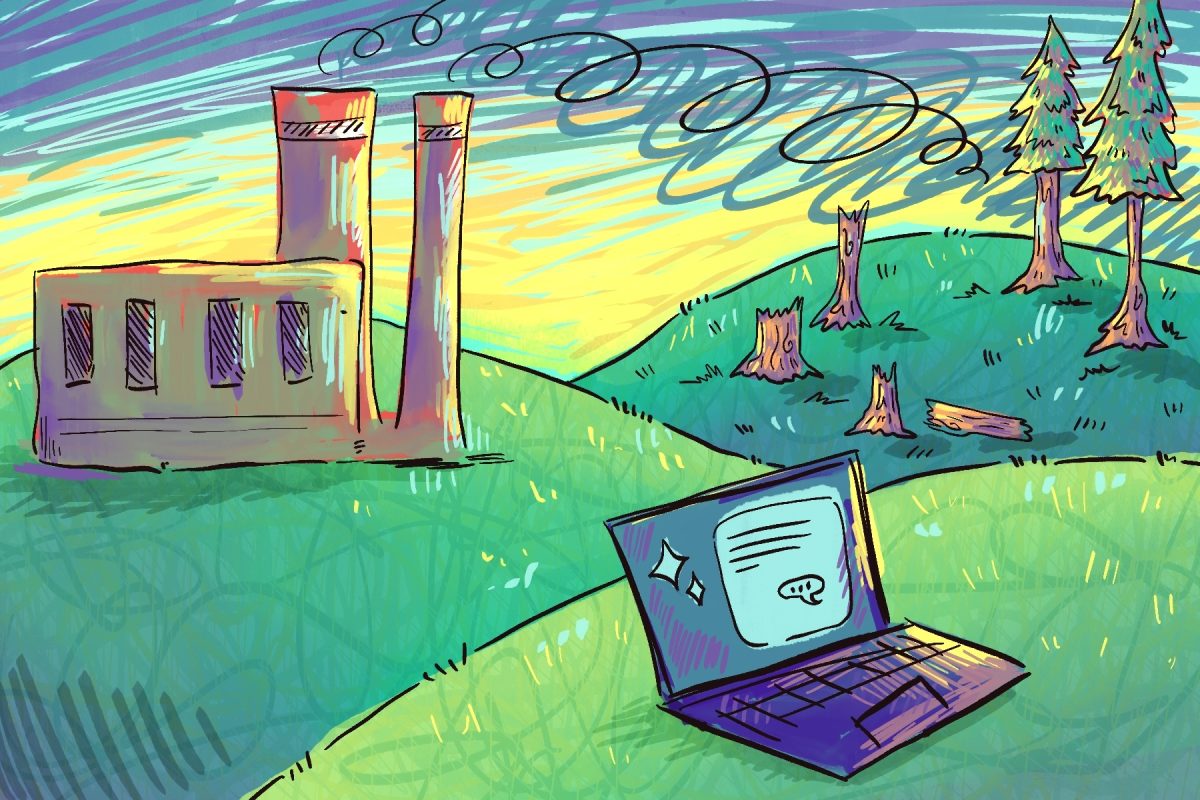


Our planet is not dying quietly. It is coughing, sweating and breaking down all around us, with a large chunk of society pretending it’s fine. Since the Industrial Revolution, fossil fuel emissions have grown at an exponential rate, reaching a record high of 37.8 gigatonnes, or approximately 83.3 trillion pounds, of carbon dioxide per year.
Yet even with that overwhelming number in front of us, it has not sparked the public or political urgency necessary for sufficient change. Instead, we seem to be taking steps backward, cutting funding for renewable energy, carbon capture and other programs meant to protect our planet.
Global warming is not a new phenomenon. In fact, there’s a large body of literature on it. From early climate models in the 1960s to modern satellite data, researchers have consistently found the same pattern: As carbon emissions rise, so do global temperatures.
While this rise might not seem immediately alarming, it is triggering different indicators all around us. One of these indicators is the bleaching of coral reefs, which has now reached its tipping point, one of the first among climate change indicators. Just this past month, studies found that more than 80% of the world’s warm-water coral reefs have been pushed past the conditions they can survive, marking the first irreversible threshold of the climate crisis.
For students here at The University of Alabama, that may not seem like a huge deal. These ecosystems are home to a quarter of all marine life and help feed a large population of people, primarily those in developing countries, while buffering coastal regions from hurricanes. More importantly, they serve as an early warning system for the climate’s stability. Heightened warming drives severe weather events, relentless heat waves and disrupted fish populations that feed into global food chains affecting, believe it or not, us.
Probably the most notable impact for us is those same heatwaves, which aren’t expected to go anywhere. In fact, Tuscaloosa is now part of the new Extreme Heat Belt, stretching from Texas to Florida, with the region being projected to experience 100-degree-plus temperatures for nearly two months each year by 2050; a factor of 5 times from current averages.
Now, I understand some might say that these issues can be pushed off, but that’s just not the case. We are part of the generation that will live with the consequences of what scientists once called “future warming,” except that “future warming” is here. The question is whether we treat these tipping points as a wake-up call or another headline to scroll past between classes.
Despair, however, isn’t the point of my piece; awareness is. The loss of coral reefs is not just some scientific milestone; it’s a moral one. It forces us to ask what kind of generation we want to be: one that watched the Earth reach its limits, or one that decided to stop pretending we had more time. The moment you start treating climate change as something real, the moment you decide to recycle, to vote, to speak up, to research or to innovate — that’s a tipping point of its own.