
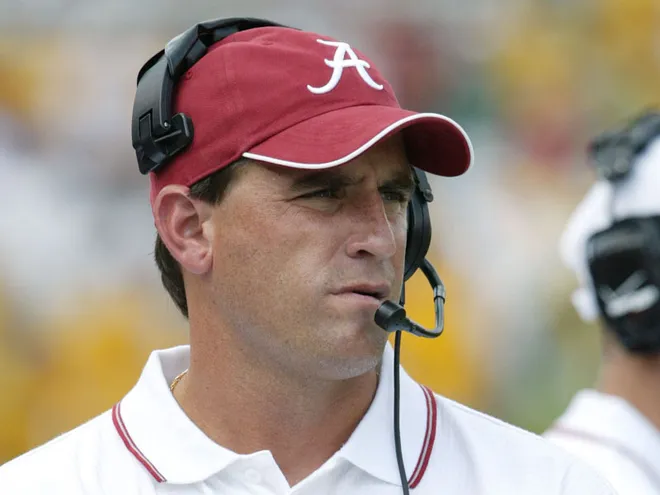
Former Alabama head coach Mike Shula, now South Carolina offensive coordinator, will face the program he led two decades ago, amidst calls from Gamecock fans for him to be fired.
He is in his second season at South Carolina and first as offensive coordinator. The Gamecocks are sitting at 3-4 – a letdown start – after beginning the season ranked No. 13 in the AP Top 25 and rising as high as No. 10.
Shula’s offense is currently ranked 115th in scoring and averages just 297.7 yards per game. It again struggled last week in a 26-7 loss to No. 14 Oklahoma, prompting some fans in attendance to berate the offense with boos.
Students at South Carolina further pushed for Shula’s dismissal when a group of students walked through campus on Tuesday, chanting “Fire Shula.” Despite the increasing criticism, head coach Shane Beamer told the media during his Sunday evening teleconference that he felt his offensive coordinator wasn’t letting the outside noise get to him.
“I think he’s been the same way that he’s been since Day 1,” Beamer said about Shula. “Look, man, the guy was the head coach at Alabama, so he’s dealt with scrutiny before. He grew up the son of the winningest coach in football history.”
He added that this season isn’t Shula’s “first rodeo.”
Shula’s offenses at Alabama often struggled to hang points on the scoreboard. None of his teams as Crimson Tide head coach averaged more than 25 points per game, and in 2005, his most successful season at the helm, the team put up an 86th-best 21.9 points per game.
In 2006, his final season at the helm, Shula’s Crimson Tide struggled down the stretch. Its offense sputtered, and it lost four of its final five games after a 5-2 start. The team also lost a fifth straight Iron Bowl in which it turned the ball over six times.
Shula was not retained after the disastrous end to a tough sledding, which saw Alabama outgain Auburn by 103 total yards yet lose by 7 points.
“Who knows what the season would have been like if we had done just a few different things?” Shula said in 2006, following the Iron Bowl. “But we didn’t. There’s a lot of accountability. It starts with the head coach, then the assistant coaches, then the players.”
His tenure began under tough circumstances, with the program ineligible for a bowl game in his first season due to NCAA sanctions stemming from former coach Mike DuBose’s stint at the helm. He was also hired well into the offseason, on May 8, 2003, following Mike Price’s contract being rescinded for inappropriate behavior.
Shula helped right the ship that DuBose and Mike Price nearly sank, providing stability in a time of need. He led Alabama to a Music City Bowl appearance in 2004 and a Cotton Bowl victory in 2005.
“The last few years have been tough for these guys. We have been through some tough times,” Shula said after the Cotton Bowl. “We stuck together. And when you go through some tough times together, you find out a lot about each other. There’s a lot of different ways you can go, and this team pulled together. And this was the result of it, 10 wins.”
While his tenure saw highs and lows, Shula helped guide Alabama football through a tumultuous period marred by sanctions and scandals. He also brought the program back into the national spotlight, soaring as high as No. 3 in the Bowl Championship Series standings in 2005.
Now, he will look to enact revenge against the program he once led as a player and coach.
No. 4 Alabama travels to Columbia, South Carolina, on Saturday to face the South Carolina Gamecocks. Kickoff is slated for 2:30 p.m. CT, and fans can tune in on ABC.