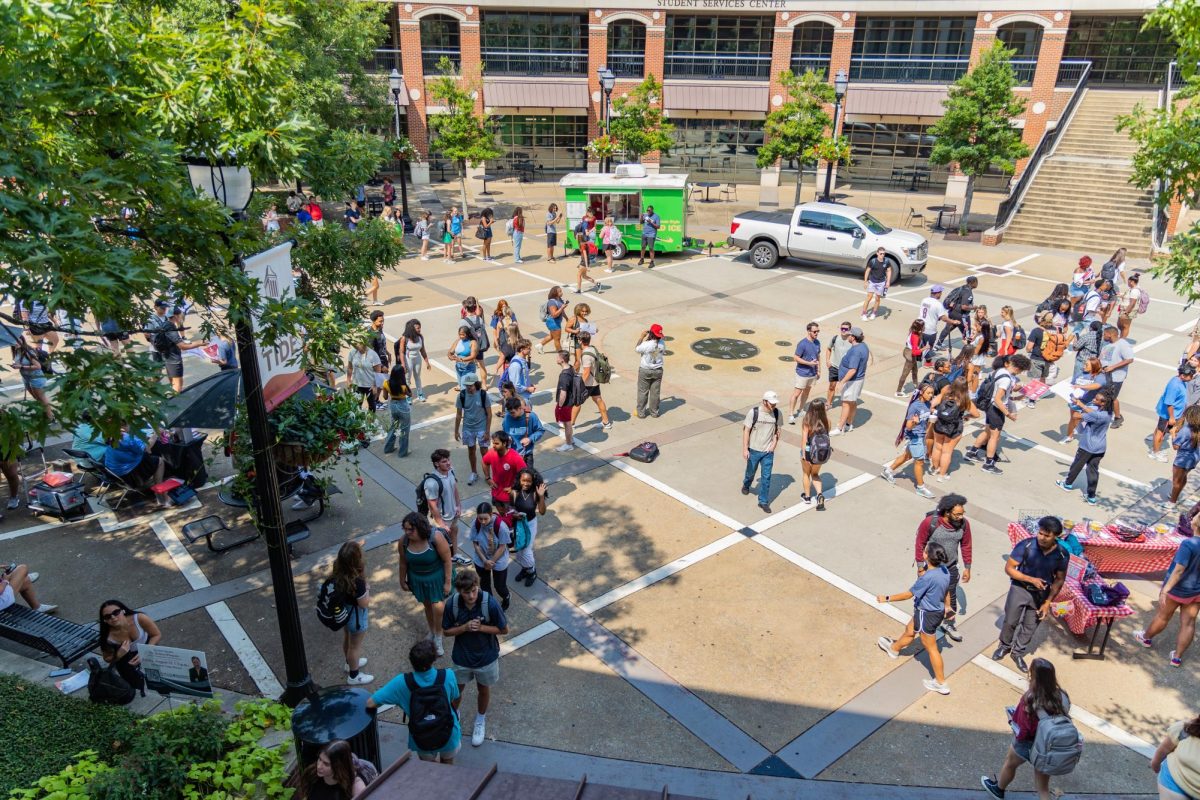


What I have always admired most about this University is not its beauty — the Quad in early autumn, fallen leaves splayed across the sidewalks and Denny Chimes humming a familiar tune off in the distance. While undeniably striking, the University’s charm has never been what defines this place for me.
What I admire most is its people.
It should come as no surprise that the Deep South is rich with history. Though Alabama’s past is heavy in nature, it is precisely this weight that makes the character of its people so remarkable. Progress in this state has never been passive; it has been carried forward by those willing to challenge existing systems and reimagine what this place could truly be.
This same spirit is rooted within the University. It lives in students who refuse to be limited by their circumstances and in faculty that consistently push the boundaries of tradition.
When Autherine Lucy Foster — one of the first Black students admitted to the University — ended her third day of school in the annex of Graves Hall in 1956, she did not leave as a student. She was escorted away, forced out by Klansmen, members of the White Citizens’ Council and students resistant to her presence.
And yet her presence here, however brief, altered the trajectory of the institution. It forced the University to confront itself.
Decades later, when The Crimson White published “The Final Barrier: 50 years later, segregation still exists,” in 2013, it exposed the persistence of exclusion within the Alabama Panhellenic Association. After an anonymous Black student did not receive a bid from any of the 16 sororities during formal recruitment, practices that had long been dismissed were brought into question.
Again, it was not the institution that initiated this reckoning; it was the people within it. Time and time again, that is the pattern that this place reveals: progress is not inherited — it is created. After a while, you will come to realize that here, growth is not accidental; it is intentional and oftentimes, uncomfortable.
So no, it is not the landscape of this campus that I find the most admirable, however picturesque it may be. It is the resilience of its people. Throughout my time here at the Capstone, I have consistently preached that those who gain the most from this University are those who choose to pour themselves into it. Those who refuse to be confined by expectations and advocate for something bigger than themselves.
When I first stepped foot on campus in August of 2023, I had little to no semblance of the woman I could be. As an out-of-state student from a small town in Texas, the only thing familiar to me at the time was pen and paper. I was freshly eighteen, carrying the quiet weight of my first heartbreak and — if you could even believe it — the least confrontational person I knew. I had spent so much of my life trying to make myself smaller. Agreeable. Easier to understand.
It was during this transitional period of my life that I stumbled upon The Crimson White. At first, it was something to hold onto. Over time, however, I found something steadier than certainty: permission. Permission to ask questions, to write with integrity and to exist here without molding myself into someone I thought I needed to be.
This kind of permission does not exist in isolation, it is demanded by the people around you. By editors who challenge your work, by peers who challenge your thinking and by friends who refuse to let you remain stagnant.
To put it simply, I have never tried to be anyone — or anything — I wasn’t. I have always worn my heart on my sleeve, whether that is reflected in my work or how I choose to show up in the world. And long after I am gone, I can only hope that I have taken the steps necessary to leave this campus better than I found it.
In the end, studying here at the University has never just been about finding my voice. It was about the people who pushed me to use it. So as we look beyond the horizon, I will leave you with this: the people truly do make the place.