

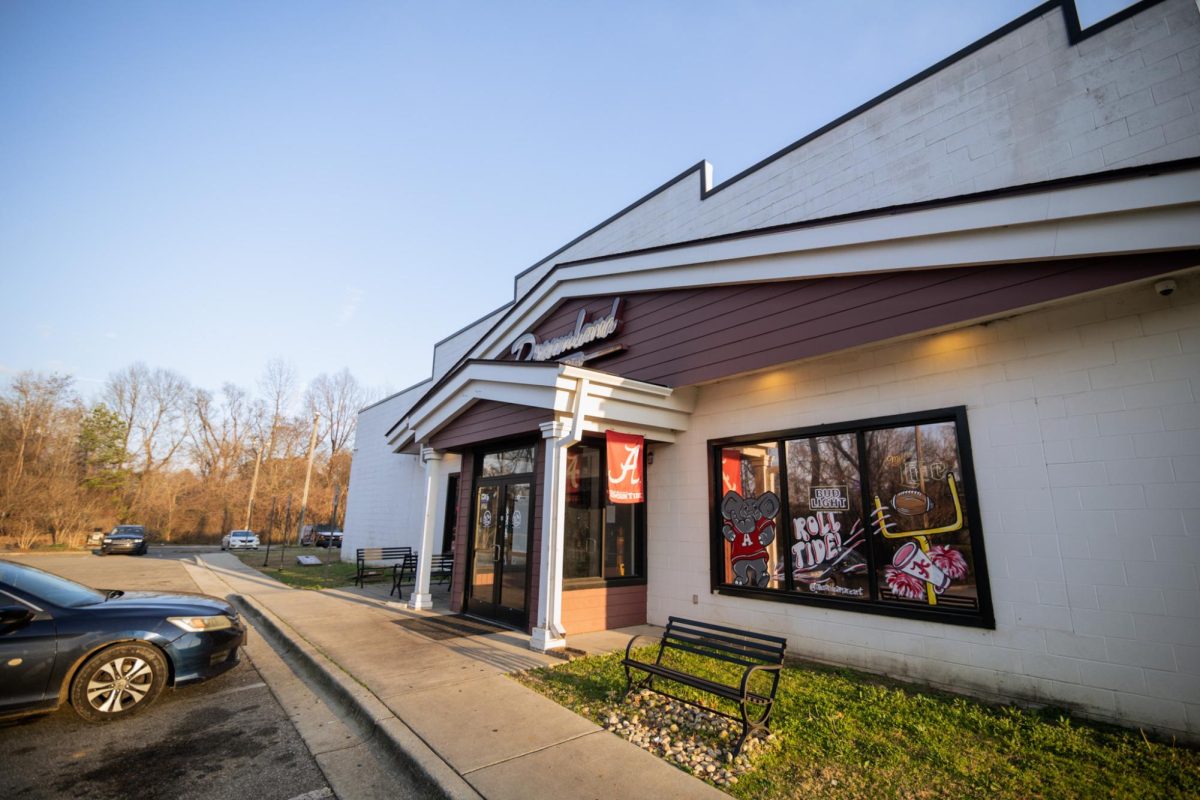
The smells of hickory smoke and vinegar waft through the doors of Dreamland Bar-B-Que long before a customer walks through the front door. With a red wooden exterior, meals served in baskets or on styrofoam plates and an air that somehow always feels like summer, it’s no surprise that Dreamland has held a top-spot on Tuscaloosa’s best eats.
The original Dreamland location opened in Tuscaloosa in 1958. While the store may no longer sell postage stamps, 60 years later some things remain consistent — a signature vinegar-based barbecue sauce, fall-off-the-bone ribs and a side of white bread served with every meal.
“People come with expectations of flavor, the texture, the smell and the environment,’” said Bo Drummer, a manager at Dreamland Bar-B-Que in Tuscaloosa. “I think it’s the pit. It’s the same pit we started out with in 1958.”
Barbecue is a dominant style of cuisine in Tuscaloosa, developing the Southern food scene and a sense of regional community. Drummer said barbecue was a food that highlights nostalgia for a lot of people, and Dreamland goes hand-in-hand with Alabama.
With the diverse options of restaurants, there are several Southern dishes, such as ribs and pulled pork, that continue to dominate the hospitality industry. Drummer said Dreamland is most known for their ribs, but also serves things like pulled pork, mac and cheese and banana pudding.
“We see a lot of students, older people, middle crowd, even folks who come from Germany, sometimes overseas,” Drummer said. “Our identity is the ribs. It’s the backbone of this place.”
Cameron Harris, pitmaster of Moe’s Original BBQ, said he thinks barbecue is a go-to food on game days because it is shareable, and most barbecue restaurants in the area offer massive catering options.
There is a sense of community when going to a restaurant, instead of ordering to-go. Dining inside of a restaurant, surrounded by family and friends, offers a casual and communal experience for consumers. The walls of the Tuscaloosa location of Dreamland are lined with a variety of license plates, throwback photos and posters to create an environment that ties in the franchise’s history, but also the people who have shaped it along the way.
“They like to come in to look at the games, look at the wall. We let people come because they heard about it, because of the story,” Drummer said. “The walls tell a story here. If you look through, you can tell the stories and how long they have been here.”
Beyond the restaurant, many Southern families eat barbecue at home. From hobbies to simply cooking for their family, there is no lack of appreciation for barbecue.
Darrin Griffin, a professor in the Department of Communication Studies, teaches a special topics course titled, “COM 495: Barbecue Communication.” Outside of the classroom, Griffin said he has always had a passion for cooking barbecue but had never thought of food as communication until coming across a Washington Post article titled, “They fed the civil rights movement. Now are black-owned barbecue joints dying?”
“This was the first time I considered food in general, especially barbecue, in this context, as a conduit of communication,” he said. “I’m the type of person I like all kinds of food, and I respect the culture and I embrace it.”
Students can’t sign up for the class; rather, Griffin interviews and handpicks them. Each class varies in locations and experiences, with Griffin teaching another class this upcoming summer semester.
Griffin has also come up with an idea of creating a barbecue club, and he recently posted an interest form to see if it is something students would want to take part in.
“I want to get an executive board together and write a constitution and try to get The SOURCE to sponsor the student club with the idea that the club would embrace the extracurricular learning of barbecue cooking culture,” Griffin said.
Dummer said that for the staff and people at Dreamland Bar-B-Que, beyond just the food, barbecue represents “family.”
“We stick together … and we’re all there for each other,” he said. “We’re a tight-knit group here.”
Editor’s note: This story was updated Feb. 27. An outdated version of this story was erroneously published.