

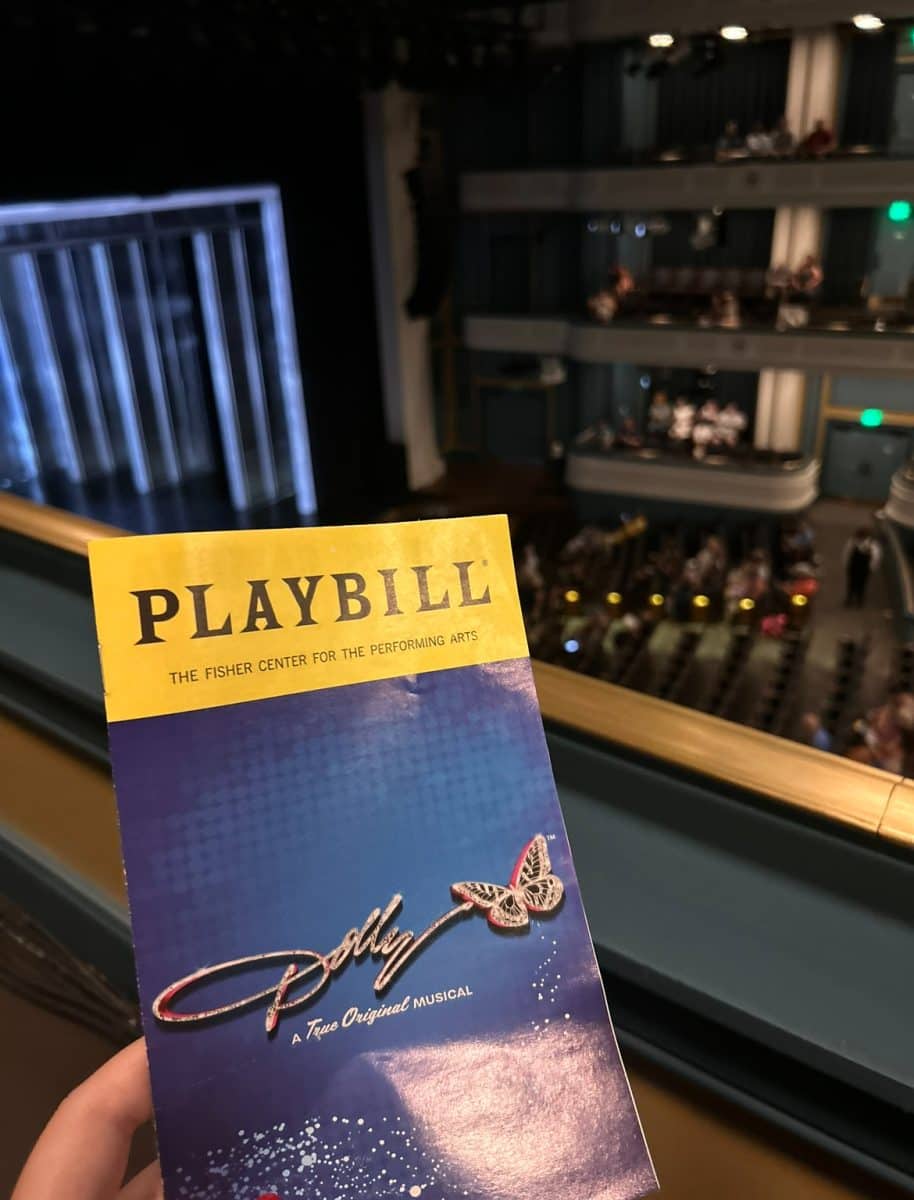
“Dolly: A True Original Musical” began its run of preview shows this summer in Nashville, Tennessee — the city where Dolly Parton herself got her start. Running from July 28 through Aug. 31 at Belmont University’s Fisher Center for Performing Arts, fans are traveling to Lower Broadway and Music Row, not Broadway in Times Square.
In the curtain speech, which was given by Parton via projection screen, she articulated that she felt it was important for this show to parallel her journey by starting in Nashville.
During a preview run, shows iron out their kinks, gauge audience responses, and for “Dolly” specifically, prepare for a premiere in New York City in 2026.
The musical offers an intimate glimpse into Parton’s life. It opens with Young Dolly, played by Quinn Titcomb, in front of a set resembling the front porch of Parton’s childhood cabin, and transitions to established musical theatre actresses Carrie St. Louis and Katie Rose Clark portraying Parton through her teenage years and adulthood.
The show thoroughly captures the essence of Parton, including some of her most career-defining hits such as “Jolene,” “I Will Always Love You” and “9-5,” as well as a new set of original songs to aid in moving the plot forward.
While it must be difficult to encapsulate over six decades of Parton’s astounding career within one performance, the show would benefit from changes to pacing and a condensing of materials to maintain audience interest before its official debut.
The pacing of the musical seemed to drag in Act 1 and breeze over critical moments in Act 2. Additionally, the run time of approximately three and a half hours is far longer than that of a typical performance. While viewers can certainly enjoy the soundtrack featuring almost 40 songs, at some points they felt repetitive or didn’t serve a clear purpose within the musical.
Aside from pacing, this production also adopted certain stylistic elements of Parton’s shorter musicals at
“Dollywood Parks and Resorts” that don’t necessarily align with the nature of this show. The closing number of the show includes a projection screen with Parton singing the final number alongside the cast that breaks the fourth wall and challenges the illusion of another actress portraying Parton.
Considering the nature of a preview run, this performance will likely be unrecognizable by the time it reaches the theatres of the Big Apple. The content and talent is outstanding, and the message of the show itself reflects the inspiration of Parton’s story. After the feedback from this preview run and the changes that will follow, this musical could easily become a “must-watch” performance next season on Broadway.